At a glance
- House clearance = a property emptied completely: all rooms, all contents.
- Dutch: huis leegmaken, woningontruiming. French: vide-maison, débarras.
- Includes carrying, sorting, removal, processing and sweeping.
- Also for offices (office clearance) and warehouses (warehouse clearance).
- Not a removal: nothing goes to a new address.
What does house clearance mean?
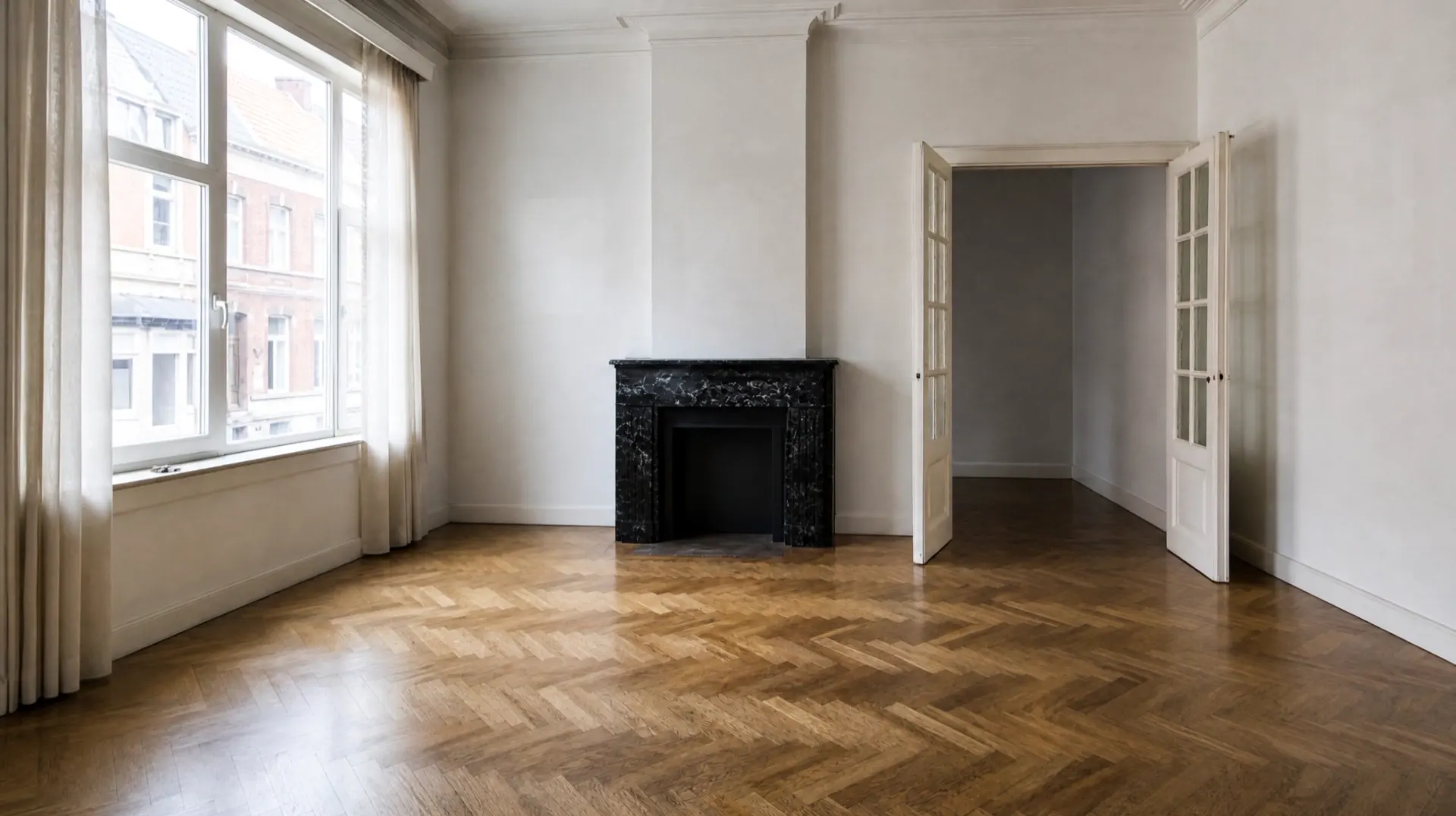
House clearance means removing the entire contents of a property: furniture, household goods, clothes, books, appliances, papers, and everything in the cellar, the attic, the garage and the garden shed. The property is left empty, with swept floors.
In Belgium you will see several words for it. Flemish companies say huis leegmaken (emptying a house), woningontruiming or leeghalen. In Brussels and Wallonia you read vide-maison or débarras. House Clearance Service uses the English term because many of the people who need it search in English: expats, international staff and families abroad.
What is included in a house clearance, and what is not?
A full house clearance includes everything needed to turn a full home into an empty one.
- emptying wardrobes, drawers and boxes
- dismantling large furniture that cannot leave in one piece
- carrying, by the stairs, the lift or a ladder lift
- sorting into reuse, recycling and residual waste
- transport to second-hand shops, the recycling park and licensed processors
- sweeping the floors at the end
What falls outside it?
Deep cleaning is not part of a clearance; the handover is broom-clean. Fixed elements such as a fitted kitchen, sanitary ware or flooring belong to a strip-out or renovation company. Hazardous substances such as paint, chemicals and asbestos need their own route. And a clearance company that charges for the work is not a dealer: it does not buy your belongings.
When do people book a house clearance?
A house clearance nearly always comes at a moment when a home changes hands or residents, and must be empty by a fixed date.
- leaving Belgium at the end of a posting or contract
- the end of a lease, before the move-out inspection
- the sale of a property, before the deed is signed
- a move to a care home or a smaller flat
- an inheritance, once the heirs have chosen what they keep
- a renovation, so the contractor can start
How does a house clearance work step by step?
A house clearance takes four steps. First you send photos of every room, with the town and the floor. Then you receive one fixed price for the whole job; how it is calculated is explained on house clearance prices.
Next you arrange what is yours to arrange: take out what you keep, request a loading bay if the street needs one, and inform the syndic in an apartment building. On the agreed day the crew empties everything and sorts as it goes. At the end every room is empty and swept.
House clearance, removal or bulky waste pickup?
In a removal, the contents go to a new address and are set up again. In a clearance, the contents do not go along: they are sorted for reuse, recycling or processing. A removal company packs and delivers; a clearance company empties and disposes.
A municipal bulky waste pickup is something else again: you put a limited number of items on the pavement yourself, on a fixed day, within a set volume. It suits a few pieces of furniture, not a whole home. For that comparison see DIY, a skip or a clearance company.
House clearance, office clearance and warehouse clearance
The idea of a clearance works for business premises too. In an office clearance we empty an office: desks, chairs, archive cabinets, kitchenette and IT. In a warehouse clearance it is racking, pallets, old stock and packaging.
The method is the same, but businesses get a quote based on photos or a floor plan. More on office clearance and warehouse clearance.
Frequently asked questions
Is house clearance the same as vide-maison or huis leegmaken?
Yes. Vide-maison (French) and huis leegmaken or woningontruiming (Dutch) describe the same service: emptying a home completely.
Do I need to be present during the clearance?
Not necessarily. What matters is that it is clear what must stay and that the crew can get in. Many people are there at the start and come back at the end.
Do you do partial clearances?
Yes, as long as it is at least one full space, such as a cellar, attic or garage. Single pieces of furniture are not collected separately.
Do clearance companies buy the contents?
Some do, especially antique dealers. We do not: we charge a fixed price to clear everything, whatever the contents are worth.