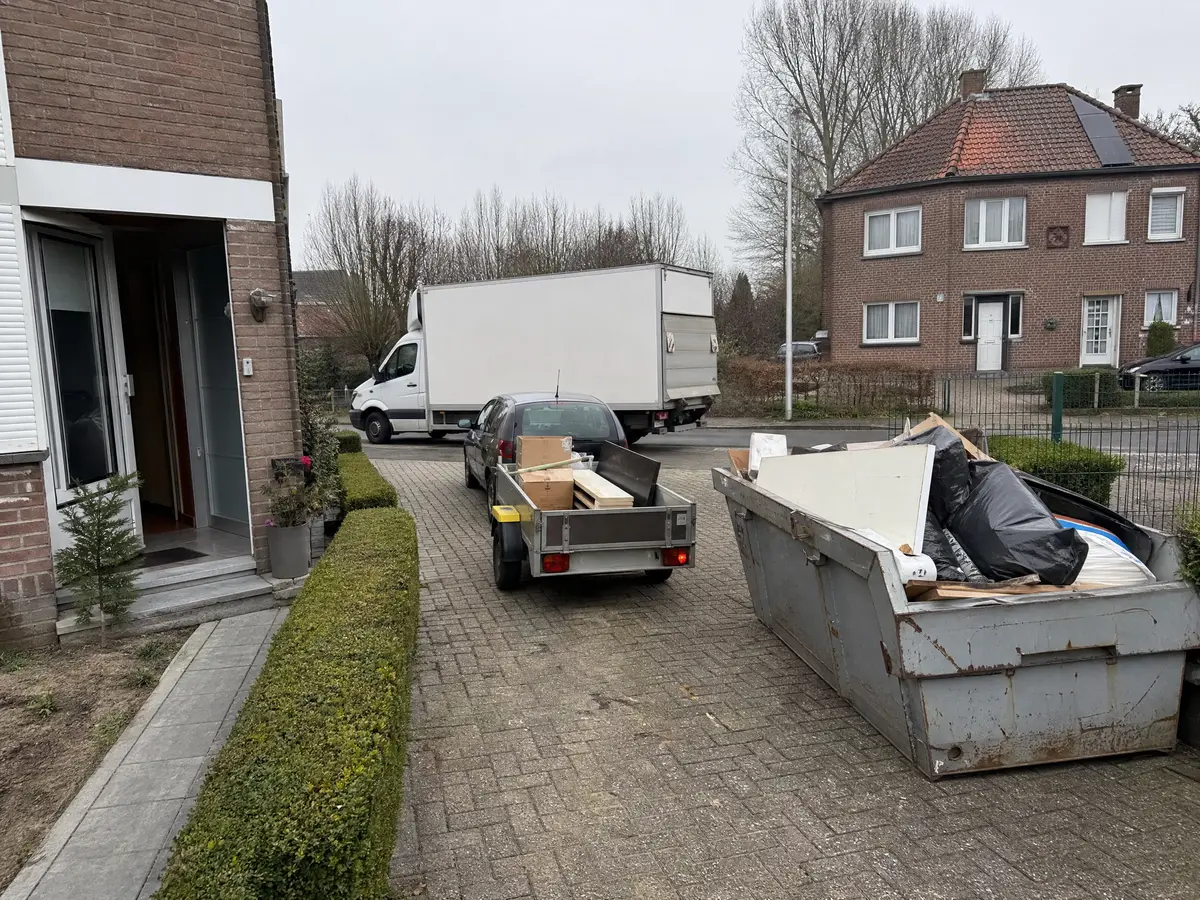
At a glance
- DIY: cheapest, but count on several days and many trips.
- Skip: useful for waste, not for reusable items or appliances.
- A skip on the public road needs a permit from the city.
- Clearance company: one day, one price, everything sorted and removed.
- Combining works: sort yourself first, then have the rest cleared.
What does clearing a house yourself involve?
Clearing a house yourself means you carry, sort and transport everything. For a full home that quickly means dozens of trips with a car and trailer to second-hand shops and the recycling park. Recycling parks have opening hours, often an appointment system and fees for bulky waste, and they are usually reserved for residents of the municipality.
Then there are the heavy pieces: an oak wall unit, a freezer from the cellar, a bed from the second floor. Without equipment and experience that is hard work, with a risk of damage to the stairs and to yourself. And if you do not have a car in Belgium, as many expats do not, it is hardly an option.
When is hiring a skip a good choice?
A skip is a good choice when there is mainly waste and you have time and helpers. You hire it for a number of days, fill it yourself, and the company collects it.
There are limits. Not everything may go in: appliances, mattresses, hazardous waste and often certain other waste types must be separate. Reusable items are lost in a skip. And a skip on the public road needs a permit from the city, with its own lead times and fees, just like a loading bay for a clearance.
When do you choose a clearance company?
A clearance company is the best choice when the property has to be completely empty by a fixed date and you lack the time or the hands. The company carries, dismantles, sorts, removes and sweeps, in one appointment and at a price fixed in advance.
That is especially true when you are leaving the country, when a rented flat must be returned on a set day, when a sale has a date for the deed, or when the property is not near where you live. How such a job runs is described in what a house clearance is.
DIY, skip or clearance: the costs compared
Doing it yourself, you pay for a van or trailer, fuel, recycling park fees and perhaps helpers. With a skip you pay the hire, the processing of what goes in, and the permit for the public road. With a clearance you pay one amount that covers everything.
For a small clear-out with mainly waste, a skip is often cheaper. For a whole home a clearance usually costs between €900 and €2,500 and saves days of work. What sets that price is on house clearance prices.
Combining: sort it yourself first, then have it cleared
Many people combine the two. First they go through the home themselves: family takes what it wants, papers are checked, good items are given away or sold. Then the rest is cleared in one go.
That is often the most efficient approach: you make the personal choices, not the heavy lifting. Agree a clear date by which everything anyone wants is out of the home. After that we plan the full contents clearance.
Frequently asked questions
How many trips to the recycling park does a full home take?
It depends on the home and the vehicle, but with a car and trailer it is quickly dozens. Recycling parks often also limit the number of visits or the volume per visit.
Can I use the recycling park if I do not live in that municipality?
Usually not with your own ID card. Each intercommunal has its own rules for non-residents and heirs; check them before you go. The city pages on this site list the local rules where we verified them.
Can I combine a skip and a clearance?
You can, but it is rarely needed: in a clearance we take everything, sorted. A skip is mainly useful for demolition or renovation work after the clearance.
What if I do not live near the property?
Then a clearance is often the only practical option. You send photos, receive a price, arrange the keys, and the home is emptied without you having to be there every day.