At a glance
- Usable furniture and household goods go to second-hand shops wherever possible.
- Wood, metal, cardboard, textiles, mattresses and appliances are recycled separately.
- Residual waste goes to the recycling park or a licensed processor.
- Papers, photos and valuables are returned to you.
- Nothing is sold by us: reuse is passed on, not traded.
How are the contents sorted during a clearance?
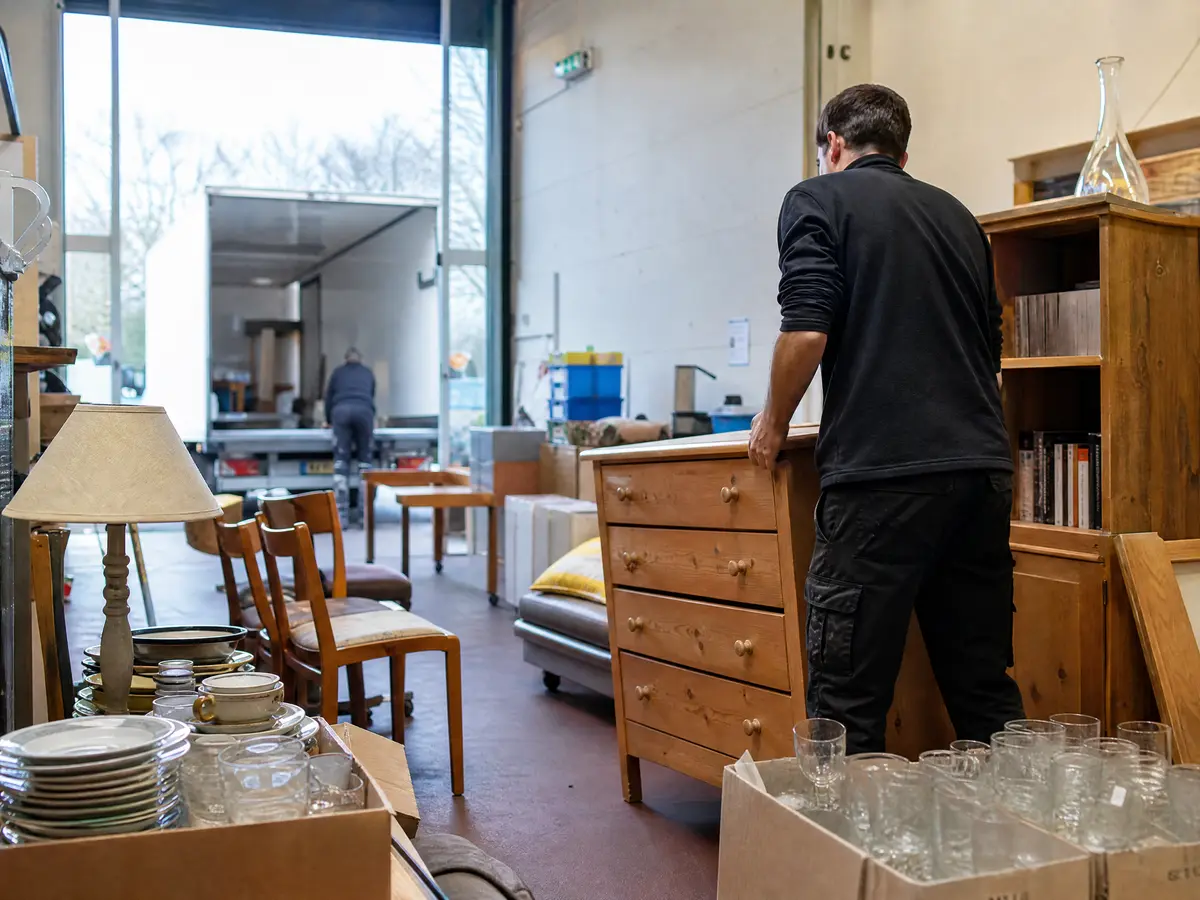
The contents are sorted the moment they leave the property, not afterwards. Each item goes into one of three streams: reuse, recycling or residual waste, inside the house and while loading the truck.
That way nothing is handled twice, and a good chest of drawers does not end up among the waste by mistake. How a complete full contents clearance runs is explained on the service page.
Which things go to second-hand shops?
Items that are in good condition and likely to find a new owner go to second-hand shops. In Flanders that is mostly De Kringwinkel, in Brussels charities such as Les Petits Riens. Think of solid wooden furniture without damage, chairs and tables, lamps, crockery, glassware, kitchenware, books and decoration.
The shop decides what it accepts. Worn sofas, damaged cabinets, stained mattresses and chipboard furniture that has already been moved once are rarely taken. Those go to recycling. We do not sell anything ourselves: what can be reused is passed on.
Which materials are recycled?
What cannot be reused is separated by material wherever possible, so it can be recycled.
- wood: wardrobes, tables, planks and chipboard furniture
- metal: shelving, bed frames, bikes, tools
- cardboard and paper
- textiles: clothes, curtains, bedding
- mattresses, which are collected separately
- electrical and electronic appliances, from a fridge to a lamp
- hard plastics and polystyrene
What happens to residual waste?
Residual waste is what can be neither reused nor recycled: mixed waste, broken items made of several materials, and soiled things. It goes to the recycling park or to a licensed processor.
The more ends up in the other streams, the smaller the share of residual waste. That is also why a home with a lot of reusable furniture is generally cheaper to clear than one with a lot of mixed waste; see house clearance prices.
What do you get back after a clearance?
Personal documents, photos, keys, bank cards, jewellery and valuables that we find while clearing are set aside and handed to you. They are often in unexpected places: an envelope between books, the bottom of a linen cupboard, a box in the attic.
We still advise looking for important papers yourself before the clearance starts, especially for an inheritance, a sale or a move abroad.
What happens to hazardous waste?
Hazardous waste, such as paint, solvents, pesticides, gas bottles, oil and asbestos, may not go with the rest. Small amounts of household hazardous waste are taken to the recycling park of your municipality yourself. Asbestos has its own rules.
Mention such products with the photos and we tell you what we can and cannot take. The spaces where they usually stand are covered in cellar, attic and garage clearance.
Frequently asked questions
Can I choose what goes to a second-hand shop?
You can point out pieces you would like to see reused. Whether they are accepted is decided by the shop, based on their condition.
Can I give things to friends or neighbours before the clearance?
Yes, and it is the best way to give good items a second life. Have them collected before the clearance, so it is clear on the day what goes.
Do you sell anything you take?
No. We are paid for the clearance. Reusable items are passed on to second-hand shops; we do not trade in them.
Are appliances recycled?
Yes, electrical and electronic appliances go to a separate recycling stream, from a fridge to a toaster.